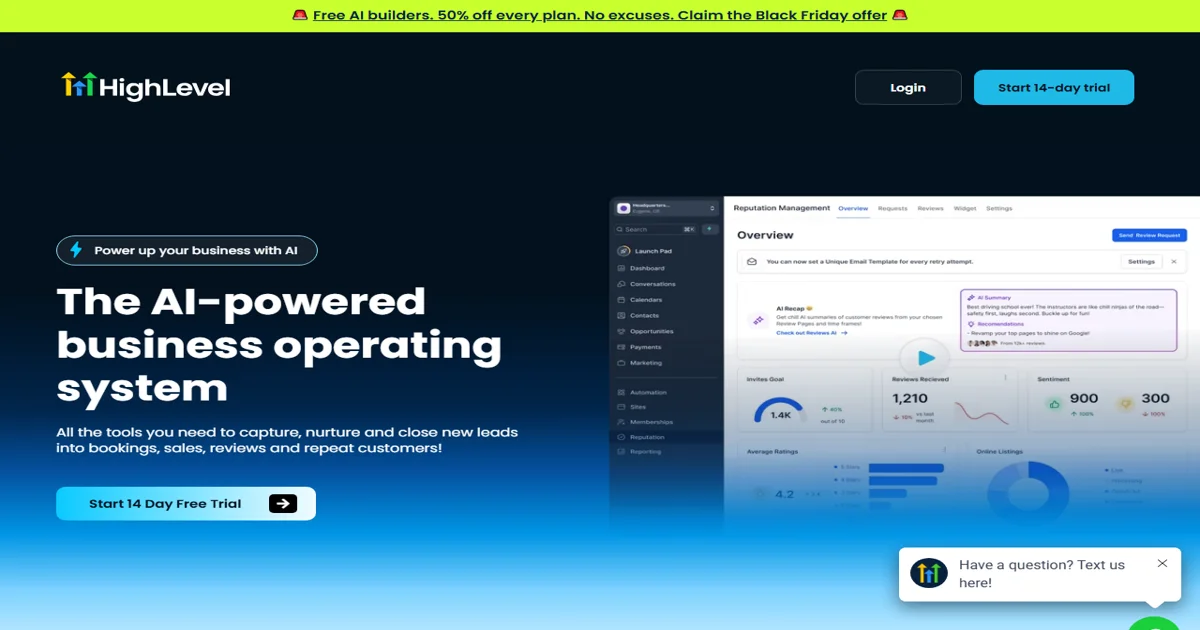
Executive Summary: GoHighLevel and HubSpot follow different CRM pricing models. GoHighLevel bundles CRM, automation, funnel building, email, SMS, phone, and booking into one flat subscription. HubSpot charges per user per hub, making costs scale with team size. Agencies that need white-labeling, sub-accounts, and predictable pricing get better value from GoHighLevel. Solo users who only need free contact management will prefer HubSpot.
- Best For: Agencies and small-to-medium businesses needing CRM, automation, and client management under one subscription.
- Pricing: GoHighLevel Starter $97/month ($970/year), Unlimited $297/month, Founder $497/month. HubSpot Starter hubs begin at a single-digit seat price on annual billing, rising to $20 per seat monthly.
- Strength: GoHighLevel includes CRM, funnel builder, email/SMS, booking, phone, and white-label features at a predictable monthly rate.
- Drawback: Steeper learning curve than standalone tools. Communication surcharges for SMS, phone, and AI can add up for high-volume senders.
See the full breakdown of features and pricing.
Table of Contents
- GoHighLevel vs HubSpot: At a Glance
- GoHighLevel vs HubSpot: Head-to-Head
- Pricing Comparison
- Features Compared
- Ease of Setup
- GoHighLevel vs HubSpot for Agencies
- Integrations
- Vendor Lock-In
- Which CRM Fits an Agency?
- Frequently Asked Questions
GoHighLevel vs HubSpot: At a Glance
What GoHighLevel Is Built For
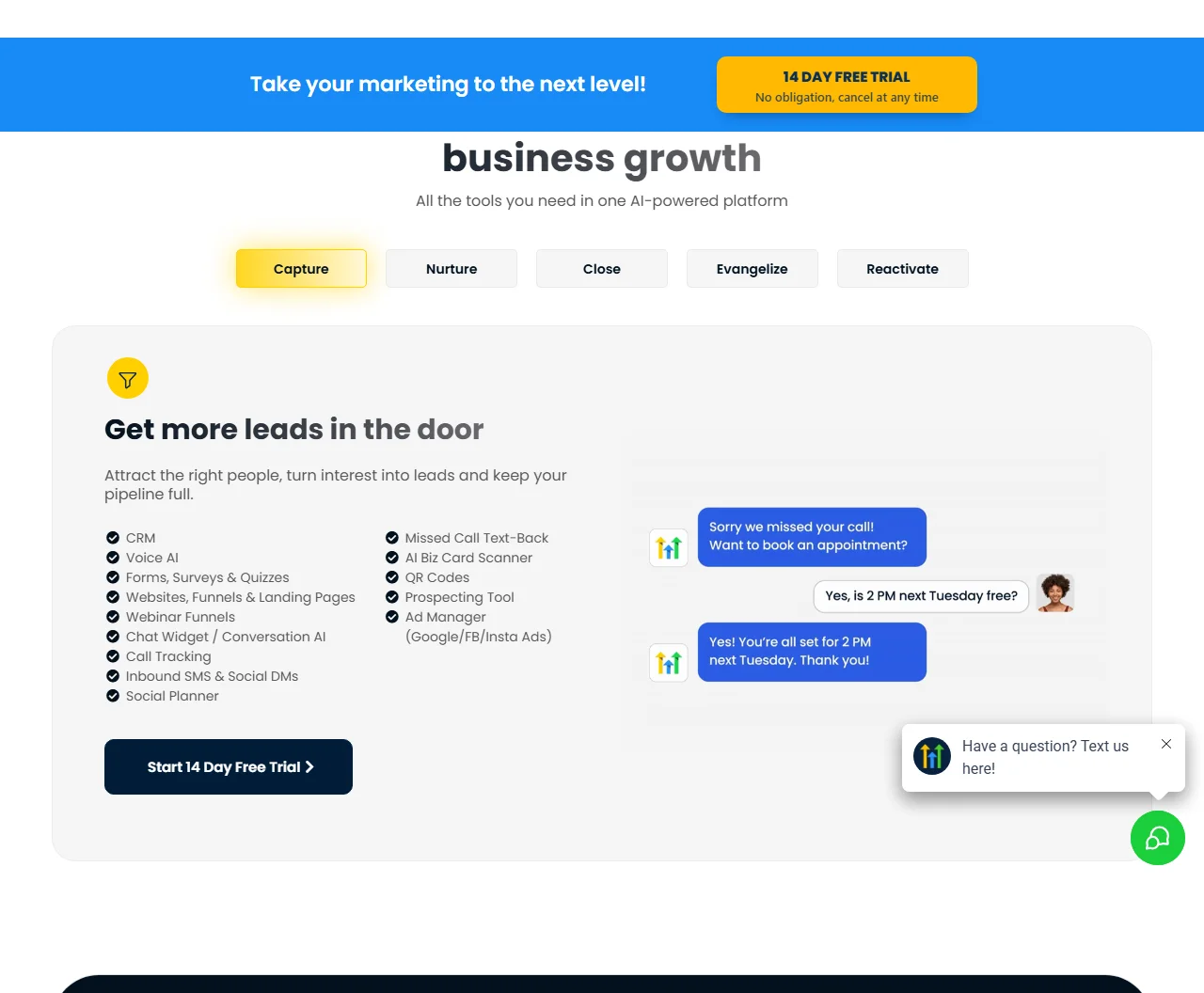
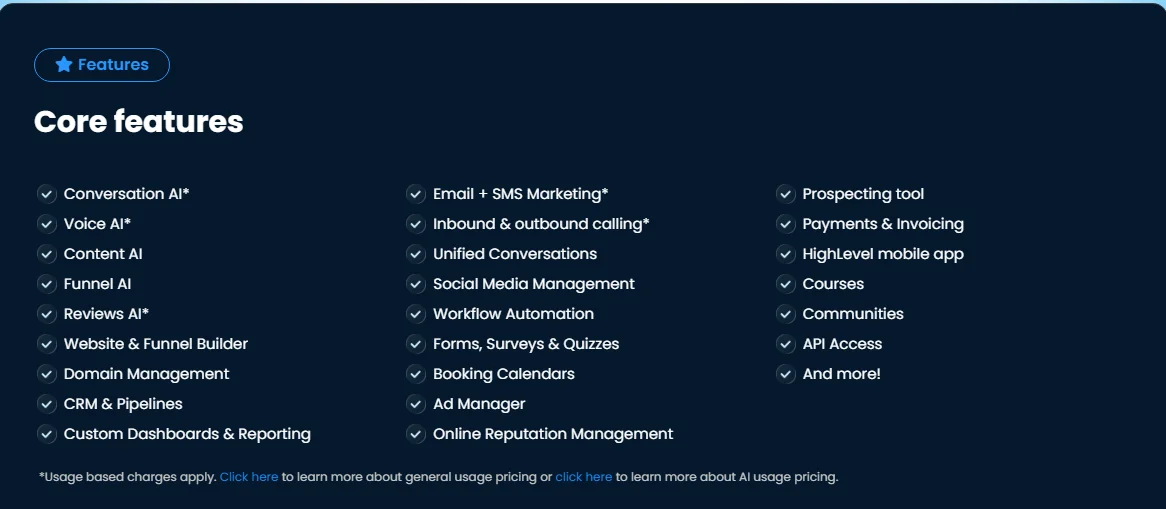
GoHighLevel started as a CRM and marketing automation platform for agencies. It includes pipeline CRM, workflow builder, email and SMS marketing, funnel builder, appointment booking, phone system, reputation management, and AI features. Sub-account management and white-label capabilities let agencies rebrand the platform as their own. Pricing is per account not per user. New to the platform? Start with our plain-English What Is GoHighLevel guide, then learn about our review methodology.
What HubSpot Is Built For
HubSpot is a modular CRM platform organized around inbound marketing. Its free CRM tier includes contacts, deals, tasks, and meeting scheduling. Paid features come through separate hubs: Marketing, Sales, Service, Operations, and CMS. Each hub charges per user with Starter, Professional, and Enterprise tiers. The full marketing-sales-service suite becomes expensive as you add hubs and users.
The Two Philosophies
The two platforms encode different philosophies about who should own the CRM. HubSpot sells a modular inbound ecosystem: you pay per user, per hub, per tier, and you assemble the exact stack your organization needs. That model fits marketing-led companies that want deep reporting, contact scoring, and enterprise governance, where the CRM is owned by a central marketing or revenue team.
GoHighLevel sells an operating account to the agency principal. The buyer is usually a marketer who resells execution to twenty or thirty local clients and needs one login, one bill, and a repeatable snapshot to clone a working setup. The platform assumes the agency, not the client, configures the pipelines and automations, so sub-accounts and white labeling ship inside the product rather than as an add-on.
HubSpot’s unique strengths show up where depth matters: Marketing Hub Professional includes multi-touch revenue attribution, its contact scoring and custom reporting are among the most mature in the category, and the App Marketplace lists over 1,000 native integrations for enterprise stacks. The philosophy breaks down for agencies because those capabilities scale per user and per hub, and there is no white-label or sub-account layer to resell under your own brand.
GoHighLevel’s philosophy breaks down in the opposite direction: the bundled interface is steeper to learn, and heavy SMS or phone users pay usage fees on top of the flat plan. When a solo operator needs only a lightweight free CRM, GoHighLevel is more platform than they need, while HubSpot’s free tier is enough. The decision is less about features and more about who owns the tool and how predictable the bill needs to be.
Imagine a hypothetical agency (an illustrative scenario, not real client data): a 7-person Denver shop serving 12 home-service clients. Marketing Hub Starter plus Sales Hub Starter at $7 a seat on annual billing costs $98 monthly for those seven seats, and marketing contacts stop at 1,000.
Moving both hubs to Professional means $980 for Marketing Hub (three core seats included, $45 for each extra seat) plus $630 for seven Sales Hub seats at $90, so about $1,610 monthly before the one-time onboarding fee. GoHighLevel Unlimited at $297 a month covers the same seven people from one account. Every figure comes from the price pages checked on November 27, 2026; your own bill depends on seats and contact volume.
Try GoHighLevel free and compare both platforms directly to see which fits your agency needs.
Three thresholds settle most of these decisions. Past roughly ten client workspaces, GoHighLevel becomes the cheaper and simpler option because one account absorbs every client. Below five seats with no reselling plans, HubSpot Starter at $7 a seat costs less than any GoHighLevel plan. Between those two ends, the deciding question is whether you will bill clients for the platform itself: if yes, only GoHighLevel’s white label and sub-account model works.
The table below compares every category in detail, including the 0.45-point weighted gap between the two platforms and the monthly cost of the same 5-person setup on each side.
GoHighLevel vs HubSpot: Head-to-Head
How the Two Platforms Compare Across Key Criteria
The table below scores both platforms on criteria that matter to agencies: pricing and hidden costs at 25 percent weight, ease of setup at 20 percent, core CRM features at 20 percent, automation depth at 15 percent, support and reliability at 10 percent, and agency value at 10 percent.
| Criterion | Weight | GoHighLevel | HubSpot |
|---|---|---|---|
| Pricing and hidden costs | 25% | 8/10 – One account price; surcharges for SMS/phone/AI | 6/10 – Per-user pricing scales fast |
| Ease of setup | 20% | 6/10 – Steeper learning curve; free trial and bootcamp | 7/10 – Free CRM is easy to start |
| Core CRM features | 20% | 8/10 – Pipelines, contacts, deals, calendar | 9/10 – Mature CRM with scoring and reporting |
| Automation depth | 15% | 9/10 – Multi-channel workflow plus AI Agent Studio | 8/10 – Enrollment-based workflows |
| Support and reliability | 10% | 6/10 – Support quality varies; premium paid support | 8/10 – Established support and partner ecosystem |
| Value for agencies | 10% | 9/10 – White label, sub-accounts, SaaS mode | 5/10 – Partner program; no white-label platform |
See the detailed plan pricing and features, and check what the free trial actually includes, before you start.
Weighted scores: GoHighLevel 7.65 out of 10. HubSpot 7.20 out of 10. GoHighLevel leads on agency features and pricing model. HubSpot leads on CRM maturity and ecosystem breadth. The gap is narrow enough that your choice should depend on whether sub-accounts and white labeling matter more than inbound marketing integrations.
This scoring table shows that while HubSpot leads in CRM maturity and ecosystem, GoHighLevel wins on agency-specific features and pricing. The weighted scores differ by only 0.45 points. For an agency managing 20 or more client accounts, the sub-account structure alone justifies choosing GoHighLevel. For a team relying on HubSpot’s existing integrations with Salesforce or Mailchimp, the switching cost may not be worth it. Choosing between funnel builders often comes down to whether the sale or the follow-up matters more, and GoHighLevel vs ClickFunnels explains which platform handles each. Budgeting for that commitment starts with the GoHighLevel Black Friday discount, which explains which plans are half price and when the rate returns to full.
Workflow Example: Lead Follow-Up Sequence in GoHighLevel
This workflow shows how an agency sets up an automated lead follow-up after a form submission:
- Trigger: Contact submits a form on your funnel page.
- Action: Add tag “new-lead” and move pipeline stage to “New Inquiry.”
- Wait: 2 minutes for internal notification to arrive.
- Action: Send SMS with text: “Hi {contact.first_name}, thanks for reaching out. We will follow up within 24 hours.”
- Wait: 24 hours.
- If/Else: If contact has not replied to SMS, send email with same message and add tag “follow-up-sent.” Else, move stage to “Contacted.”
- Action: Add to campaign “Standard Nurture Sequence” with a 5-email drip over 14 days.
- Action: Notify agency owner via internal email with lead name and pipeline link.
Pricing Comparison: GoHighLevel vs HubSpot
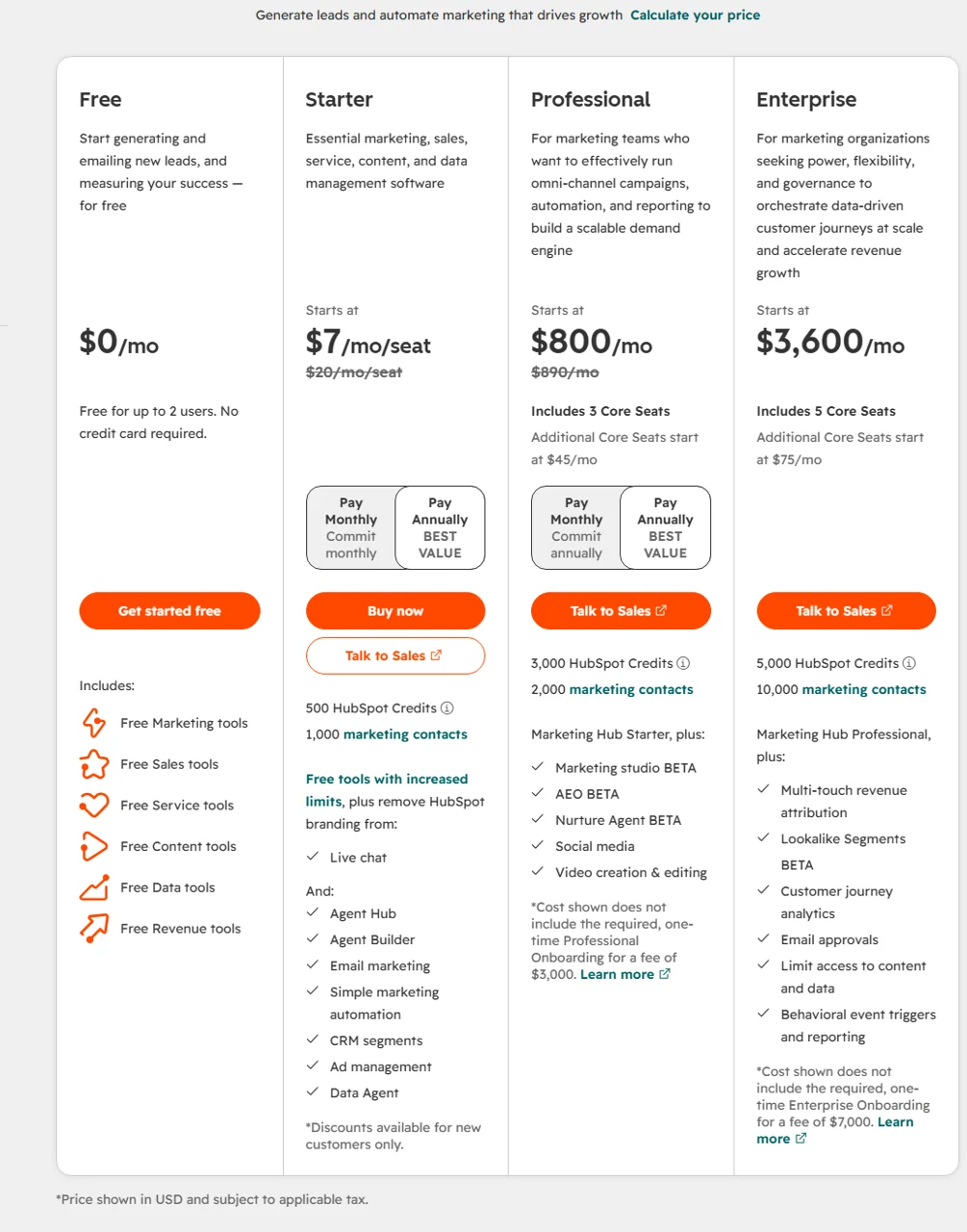
As of November 27 2026, GoHighLevel charges one flat account price for unlimited users, while HubSpot charges per seat per hub and its Professional Marketing Hub alone starts at $800 per month; the gap widens the more seats and hubs an agency needs.
GoHighLevel Pricing – Flat Fee Per Account
- Starter: $97 per month ($970 per year) – core CRM, email and SMS marketing, funnel builder, calendar, up to 3 sub-accounts.
- Unlimited: $297 per month – everything in Starter plus unlimited sub-accounts, white label, LC Phone, and AI features.
- Founder: $497 per month – everything in Unlimited plus snapshot marketplace, SaaS mode, and priority support. Compare every tier in our GoHighLevel pricing breakdown.
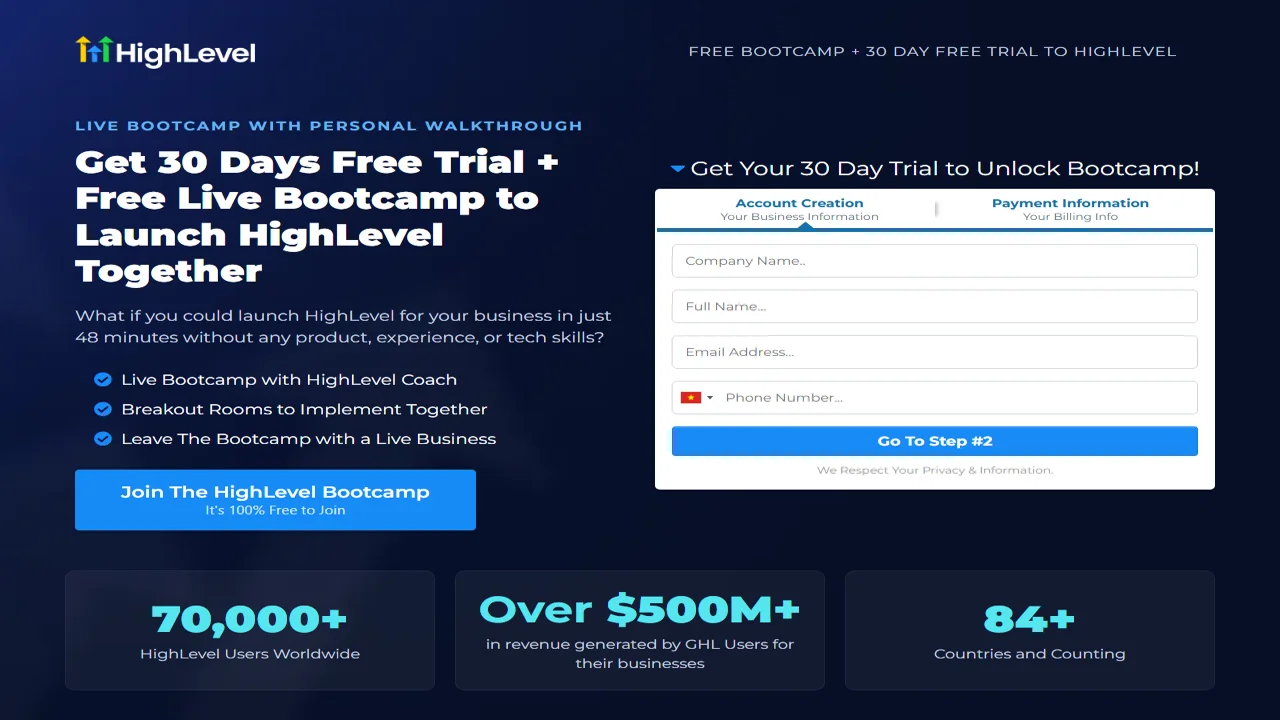
A free trial is available on any plan. Through the HighLevel Bootcamp link, a 30-day free trial with live onboarding is available. Communication surcharges may apply, US-based SMS requires A2P 10DLC registration, and plans renew automatically on the billing cycle, so review the refund policy before you commit.
HubSpot Pricing – Per User Per Hub
HubSpot does not publish a single all-in price. Costs depend on which hubs and how many users you need.
- Marketing Hub Starter: seven dollars a seat per month with annual billing (email marketing, forms, and basic analytics under a 1,000 marketing contact cap).
- Sales Hub Starter: the same $7 seat rate buys sequences, meeting booking, and deal tracking.
- Data Hub Starter: the same seven-dollar seat rate syncs data, maps fields, and maintains data quality, and Service Hub Starter matches that number.
Cost Example: 5-Person Agency
GoHighLevel Unlimited costs $297 per month flat for all users. Add $30 to $60 for SMS and phone usage. Total roughly $327 to $357 per month. Every client gets a separate sub-account. Browse more CRM comparisons.
HubSpot Starter pricing is per seat: Marketing Hub Starter at $7 times 5 seats equals $35 per month, Sales Hub Starter at $7 times 5 equals $35, and Data Hub Starter at $7 times 5 equals $35. Three hubs for a 5-person agency total $105 per month, still capped at 1,000 contacts with basic automation.
Upgrading to HubSpot Professional tiers changes the math: Marketing Hub Professional starts at $800 per month for 3 core seats (plus $45 per additional seat), Sales Hub Professional at $90 per seat per month, and Data Hub Professional at $720 per month for one core seat. Putting the same five people on all three Professional hubs costs about $2,060 a month: $800 for Marketing Hub, $90 for the two extra core seats at $45 each, $450 for five Sales Hub seats at $90, and $720 for Data Hub. HubSpot still has no built-in sub-account feature for client separation, and the Marketing Hub price excludes a one-time $3,000 Professional onboarding fee listed on the same pricing page.
For teams needing the full marketing, sales, and operations stack, GoHighLevel is the more affordable choice. For solo CRM users, HubSpot free tier works well.
Features Compared: CRM, Automation, Marketing, and Sales
CRM and Pipeline Management
Both platforms offer contact management and deal pipelines. GoHighLevel handles individual and company records with custom fields and pipeline stages. It includes a built-in calendar syncing with Google Calendar. HubSpot CRM excels in contact scoring and reporting. For agencies with many client pipelines, GoHighLevel sub-accounts keep data separate without needing multiple portals.
Marketing Automation and Workflows
GoHighLevel workflow builder uses triggers, actions, and conditional branches with multi-channel sequences combining email, SMS, voicemail drops, and WhatsApp. The HubSpot workflow engine with comparable capabilities requires Marketing Hub Professional, which starts at $800 per month. GoHighLevel provides workflow automation in every plan including the $97 Starter tier.
Email, SMS, and Phone
GoHighLevel includes native email, two-way SMS and MMS, and a built-in phone system with call tracking and voicemail. HubSpot email has templates and A/B testing but SMS requires integration and phone is an add-on. GoHighLevel is stronger for multi-channel outbound sequences.
Ease of Setup and Learning Curve
GoHighLevel has a steep learning curve because it bundles many tools in one interface. A free trial and live bootcamp with guided onboarding help new users get started. HubSpot free CRM is simpler initially but layering on hubs brings back the learning curve and each hub needs separate configuration.
GoHighLevel vs HubSpot for Agencies
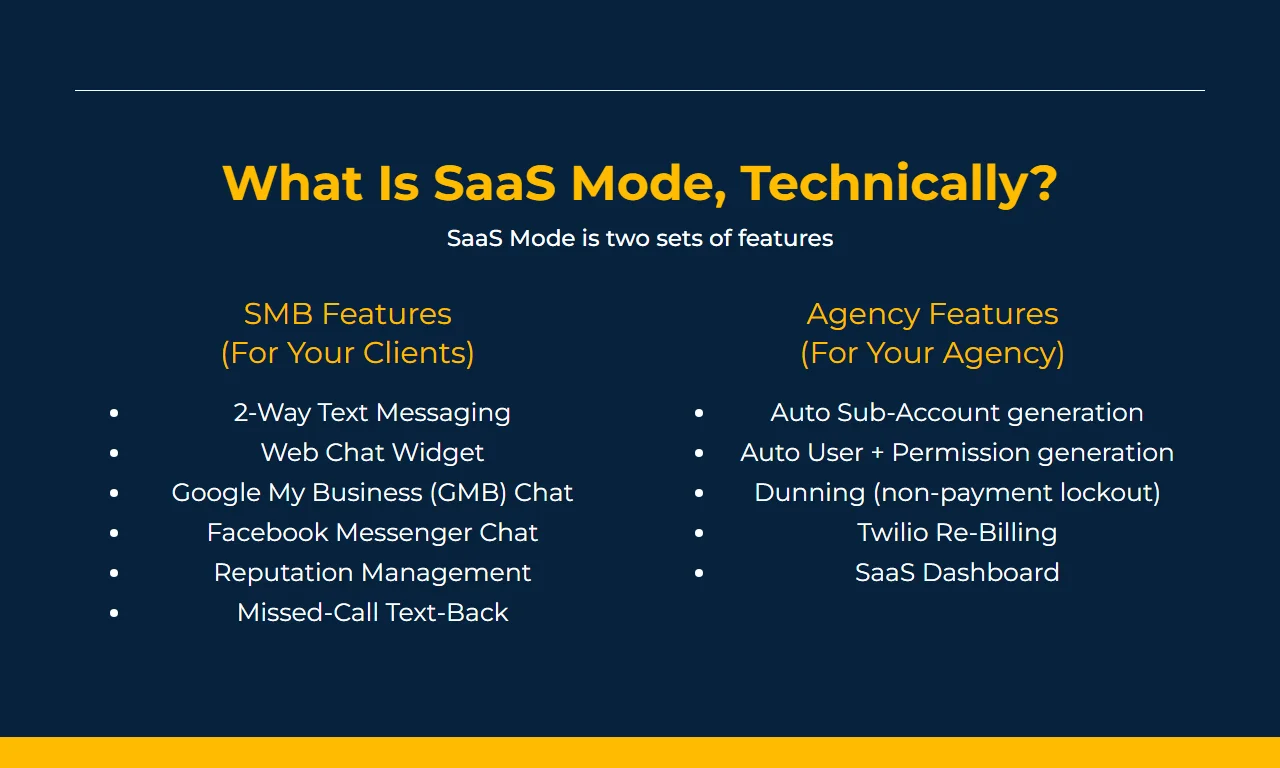
GoHighLevel was built for agencies that manage many client accounts under one roof, and it adds sub-accounts, white labeling, and SaaS rebilling features that HubSpot’s modular per-user platform does not match at any tier, which is why resellers and multi-location businesses choose it.
- Sub-accounts: Each client gets an isolated sub-account with separate CRM, pipeline, and automations managed from one master account.
- White labeling: Unlimited and Founder plans let you replace all branding with your own logo, domain, and mobile app name.
- Rebilling and SaaS mode: Mark up SMS rates, add subscription fees, and resell the platform as your own branded SaaS.
Integrations and Ecosystem
HubSpot App Marketplace has over 1,000 native integrations. GoHighLevel covers the tools agencies use most: Facebook Lead Ads, Google Calendar, Stripe, Zapier, Twilio, and WordPress. Through Zapier, GoHighLevel connects to thousands of other apps. HubSpot leads in enterprise breadth. GoHighLevel leads in per-user cost because integrations do not require per-user licensing.
Vendor Lock-In and Exit Options
GoHighLevel exports contacts via CSV and offers snapshots with full configurations. No native migration tool to other CRMs exists. HubSpot provides data export through UI and API with third-party migration tools. Both platforms present similar switching friction primarily in workflow rebuilding rather than technical limitations.
Workflow rebuilding, not data export, is what makes a switch expensive. Budget two to three weeks for the first client rebuild if you move either direction.
Which CRM Fits an Agency?
Choose GoHighLevel if you run an agency or multi-location service business that needs CRM, automation, email, SMS, phone, funnel building, and booking at a flat monthly price. White-label and sub-account features make it the best CRM for agencies managing client work in one dashboard. The learning curve is real but the bootcamp and trial give you time to evaluate. Browse the GoHighLevel pricing review.
Choose HubSpot if you are a solo operator needing free CRM with light email, or if your company requires enterprise features like multi-touch attribution or deep Salesforce integration. HubSpot pricing becomes more expensive than GoHighLevel once you need more than basic CRM.
Try GoHighLevel free and evaluate your agency workflow with the full feature set available.
Frequently Asked Questions
Is HubSpot better than GoHighLevel for small agencies?
GoHighLevel is usually the better fit for small agencies with 3 to 10 users managing multiple clients because one account holds every client workspace without per-seat math. HubSpot works better if you only need a free CRM with optional add-ons.
How much does GoHighLevel cost compared to HubSpot?
GoHighLevel starts at $97 per month for the entire account. HubSpot Marketing Hub Starter is $7 per seat per month when billed annually. For a 5-person team, comparable GoHighLevel functionality costs $297 per month on Unlimited, while a 3-hub HubSpot Starter stack runs about $105 per month and all three Professional hubs push past $2,000 per month.
Which CRM has better automation features?
Both platforms have strong workflow builders. GoHighLevel includes multi-channel sequences in every paid plan. On HubSpot, the same automation depth sits behind Marketing Hub Professional, a tier that begins at four figures of annual spend.
Can GoHighLevel replace HubSpot for an agency?
Yes for most agencies not relying on enterprise HubSpot features. GoHighLevel matches or exceeds HubSpot on CRM, automation, and agency tools like white labeling and sub-accounts.
Does HubSpot offer a free CRM plan?
Yes, HubSpot free CRM includes contacts, deal pipelines, meeting scheduling, and live chat. GoHighLevel offers a free trial on all plans and a 30-day trial through the live bootcamp.
Which platform is better for SMS marketing?
GoHighLevel includes native two-way SMS with automation triggers, templates, and compliance tools. HubSpot SMS requires third-party integration. GoHighLevel is stronger for SMS campaigns.
Should I switch from HubSpot to GoHighLevel?
If your monthly HubSpot bill exceeds $500 and you need sub-accounts for client management, moving to GoHighLevel Unlimited at $297 per month can lower your costs by over 40 percent. If you only rely on HubSpot free CRM, switching is not necessary unless you need built-in funnel building or phone and SMS features.
Try GoHighLevel free and decide for yourself.
Previous: GoHighLevel Free Trial: What You Get | Next: What Is GoHighLevel? A Plain-English Guide
About the Author

Nathaniel Brooks is a software reviewer who has spent ten years using, comparing and writing about SaaS products across CRM, email marketing and marketing automation. He writes and edits Agency CRM Hub, where he publishes independent guides to GoHighLevel: what it costs, how to set it up, how to fix it when it breaks, and how it compares with other platforms. His reviews follow the real workflows agencies and small businesses depend on, from capturing a lead to following up, booking and getting paid, and they include the downsides, usage fees and learning curve, not just the feature list.
Disclosure: We are an independent entity from HighLevel. We are not an agent or employee of HighLevel and have no authority to make binding contracts or represent HighLevel. We receive referral payments from HighLevel. The opinions expressed here are our own and shall not be interpreted or considered as representations, guarantees, or statements made by HighLevel Inc or any of its subsidiaries, agents, or assigns.
Try GoHighLevel Free